Data Center Cooling: Pumps, Compressors and Liquid Cooling

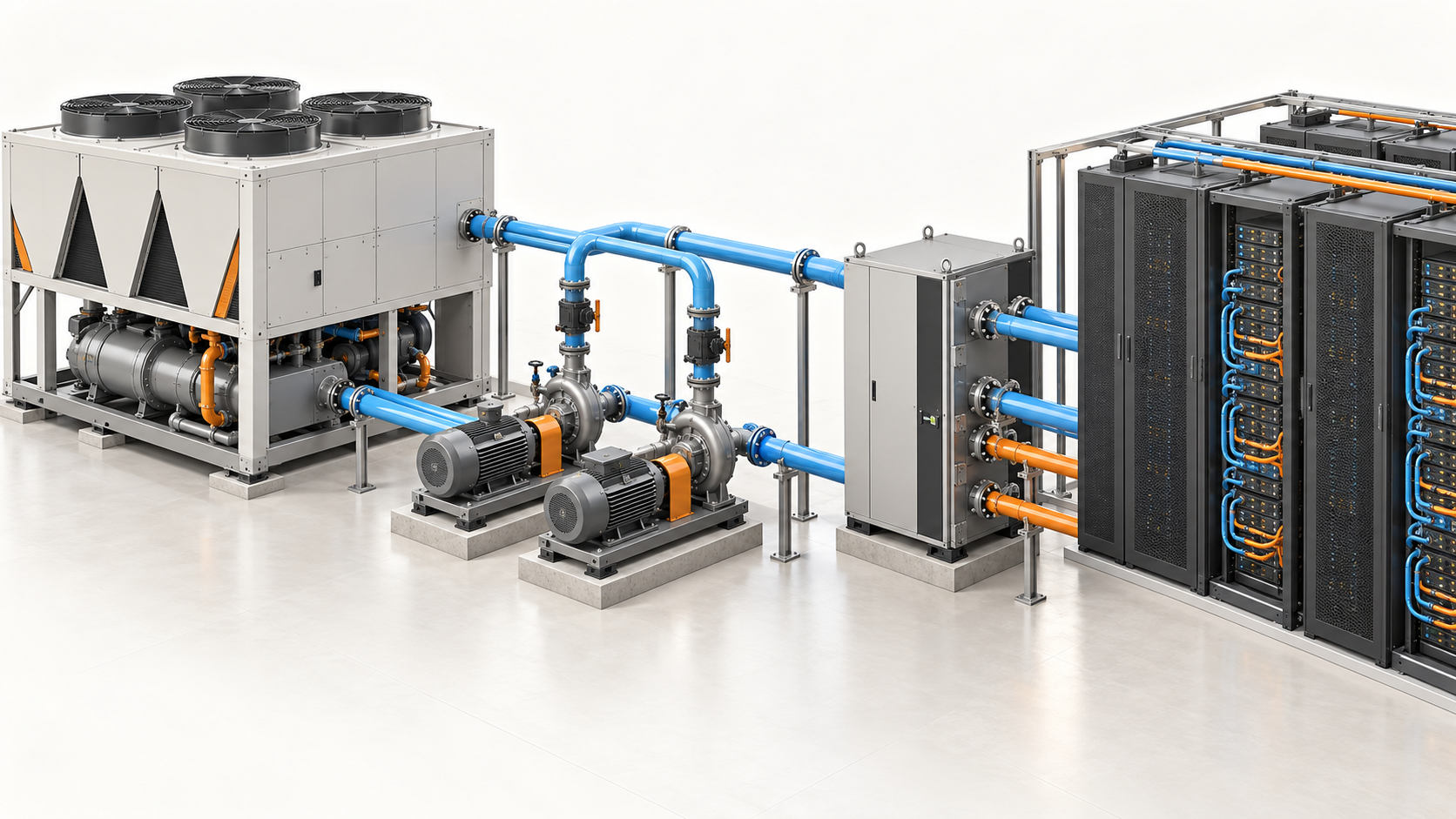
Data center cooling relies on rotating equipment to move heat away from computing systems. Pumps circulate liquid, fans move air, and compressors provide refrigeration where the cooling design requires it. Understanding these different jobs helps engineers discuss efficiency, resilience, and maintenance without treating every cooling system as the same.
What do pumps do in a data center?
In a chilled-water system, pumps circulate water between cooling equipment and the loads served. Other designs use liquid circuits to carry heat from computing equipment through heat exchangers. A coolant distribution unit, or CDU, can separate the facility loop from the technology cooling loop. The exact arrangement depends on the cooling architecture. DOE’s design guide covers chilled-water systems, air handlers, and direct liquid cooling. Read the DOE data center design guide.
Where do compressors and fans fit?
A refrigeration compressor works with refrigerant as part of a cooling cycle. It has a different duty from a water pump or an industrial compressed-air machine. Fans move air through equipment and heat-transfer surfaces. Before comparing products, identify the fluid, the cooling process, and the operating conditions.
Industrial air compressors include reciprocating, rotary screw, scroll, and centrifugal designs. Those categories are useful background, but an air-compressor comparison does not by itself specify a data center chiller. Use the refrigeration equipment manufacturer’s performance data for that application. Explore Atlas Copco’s explanation of air-compressor types.
What should a cooling pump specification include?
A useful supplier discussion starts with a clearly defined duty rather than a pump size selected in isolation. Prepare the following information so proposals can be compared on the same basis:
- Cooling arrangement: identify the loop served, connected equipment, and required operating modes.
- Fluid: record the fluid specification and expected temperature range.
- Duty points: provide required flow and head for normal, reduced-load, and planned expansion conditions.
- Availability: describe how the system must operate when equipment is being maintained or is unavailable.
- Controls: define monitoring, speed control, alarms, and the interface to facility controls.
- Service access: consider isolation, maintenance space, replacement access, and spare-parts support.
Can variable-speed pumps reduce cooling energy use?
Variable-speed operation is an efficiency option to assess when demand changes. DOE identifies speed control for chilled-water pumps, condenser-water pumps, and cooling-tower fans among potential cooling-system improvements. The result depends on the complete system and its control strategy; fitting a drive alone is not a guaranteed saving. See DOE cooling-system efficiency measures.
How are cooling, electricity, and water use connected?
Cooling equipment adds to a data center’s facility energy demand. Some cooling arrangements also consume water. Power usage effectiveness (PUE) compares total facility energy with IT equipment energy, but a power metric alone does not describe water performance. DOE discusses water use and opportunities to improve cooling operation in federal data centers. Read DOE’s data center cooling-water guidance.
When reviewing on-site power generation and gas turbines for data centers, include the essential cooling loads and their restart requirements in the discussion. Electrical and mechanical teams need a shared view of the operating scenarios.
Common questions about data center cooling equipment
Does liquid cooling eliminate every fan or chiller?
Not necessarily. DOE describes different air and liquid cooling arrangements. The heat still needs a path from the IT equipment to the final heat-rejection system, and the equipment required depends on that design.
Is there one best pump for all data centers?
No. Compare pumps against the actual fluid, flow, head, controls, and service requirements. A model suited to one loop should not be assumed suitable for another.
What information helps with a cooling reliability discussion?
Record the equipment type, operating duty, observed symptoms, relevant trends, and recent changes. Clearly distinguish measured information from assumptions. This makes an engineering discussion more useful than a description such as “the cooling is not working.”
Learn and connect with rotating equipment professionals
Start with pump fundamentals or browse the technical article library. Sign up to connect with the Rotate-Pro community and access jobs and events. Already a member? Sign in.